Cloud Server overview
Cloud Server is the Virtual Machine (VM) service running on LANIT's cloud infrastructure. You spin up servers fast, change resources on demand and operate them however you need.
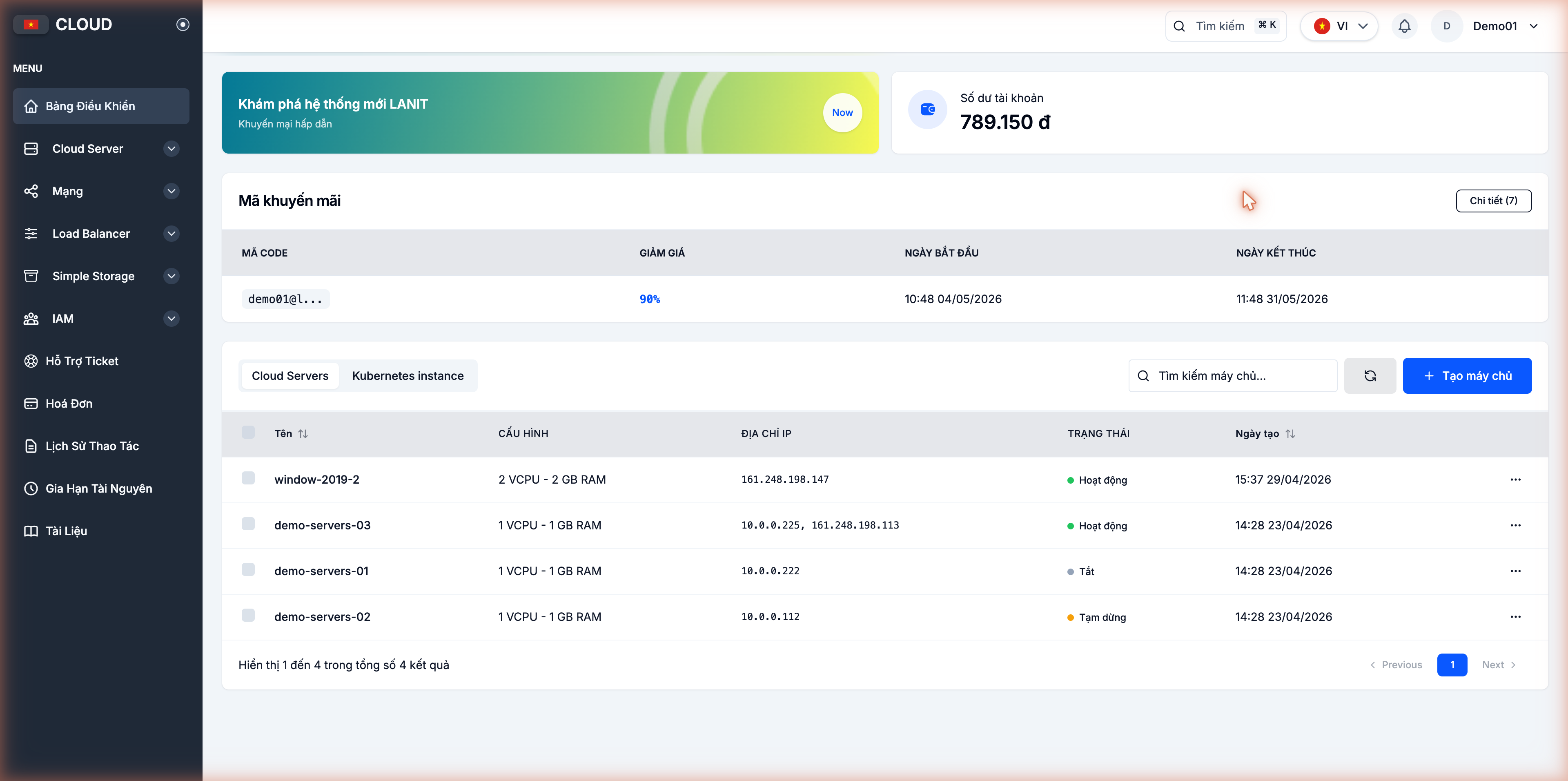
What is a Cloud Server?
Each Cloud Server has its own vCPU, RAM, disk and operating system — just like a physical server. The difference is the virtualisation layer: VMs run on a cluster of linked physical hosts, so resources scale flexibly and VMs can move between hosts during maintenance without downtime.
Cloud Server fits:
- Web hosting — WordPress, Joomla, custom web apps.
- APIs & application backends — Node.js, Go, Java, .NET, Python.
- Databases — MySQL, PostgreSQL, MongoDB, Redis.
- Dev / test / staging environments — flip on and off as needed.
- Internal business systems — ERP, CRM, file server.
The infrastructure lives in LANIT Data Center, certified Tier III for stability, security and high availability.
Highlights
Self-service and flexibility
You create, configure and operate Cloud Servers entirely from the Portal — no tickets needed. Supports many OS images (Ubuntu, CentOS, AlmaLinux, Rocky Linux, Debian, Windows Server) and lets you boot from a snapshot or a custom volume.
Scalable
Upgrade vCPU, RAM and storage as demand grows — many operations don't even need a restart. When traffic rises, combine with a Load Balancer to scale out horizontally.
Security and data safety
- Tenant isolation at the infrastructure layer.
- Security Groups for per-VM firewall control at the network layer.
- Snapshots and Backups for recovery after incidents.
- 2FA protects access to the Portal.
Stable performance
Modern hardware with SSD NVMe for IOPS-heavy workloads. Default 10 Gbps internal network and 300 Mbps Internet per VM.
Get started
- Create a new VM — the first-VM flow.
- Access the VM via SSH / RDP — sign in from your local machine.
- Snapshot and Backup — save the VM state.
- Manage volumes — attach extra storage to a VM.